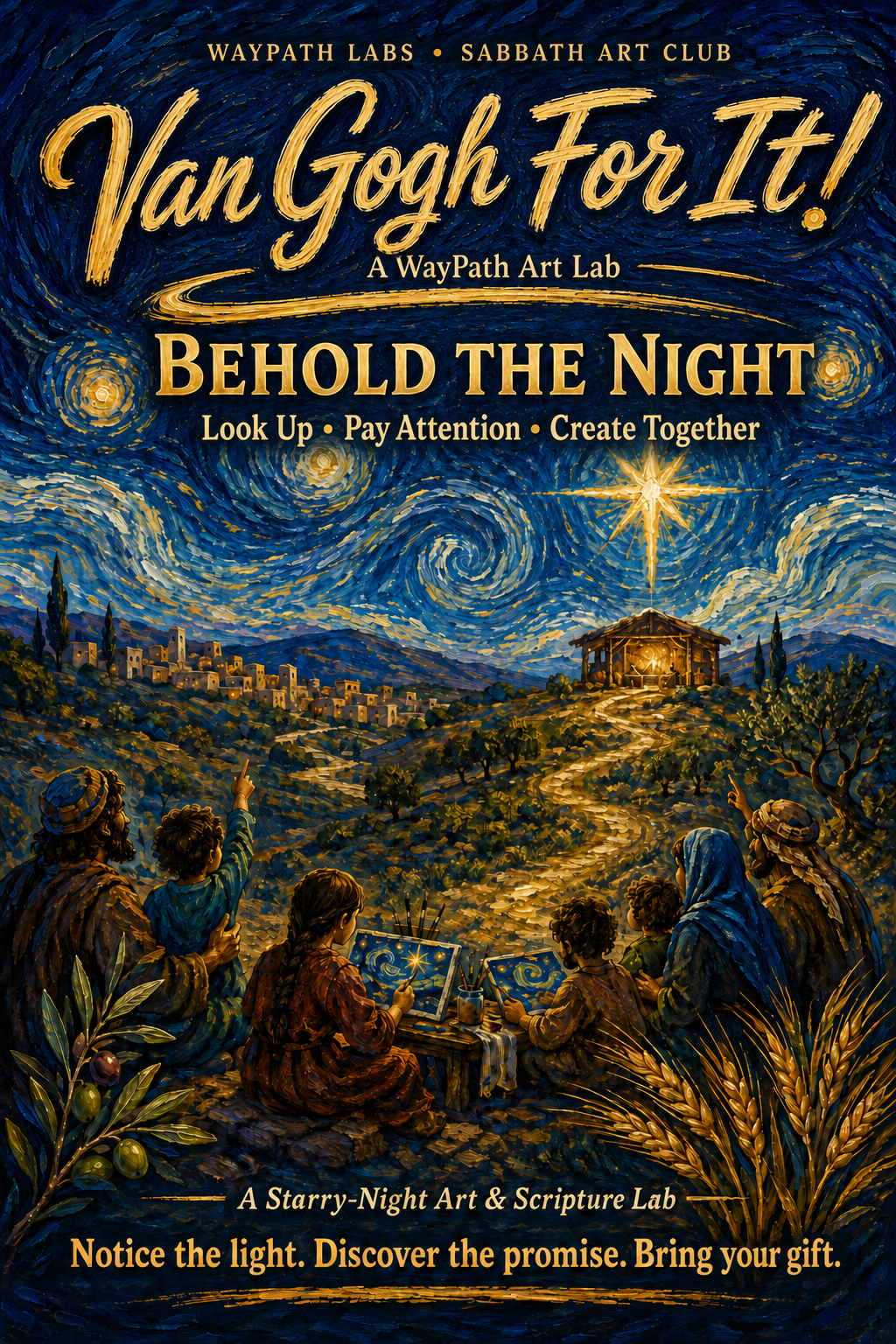

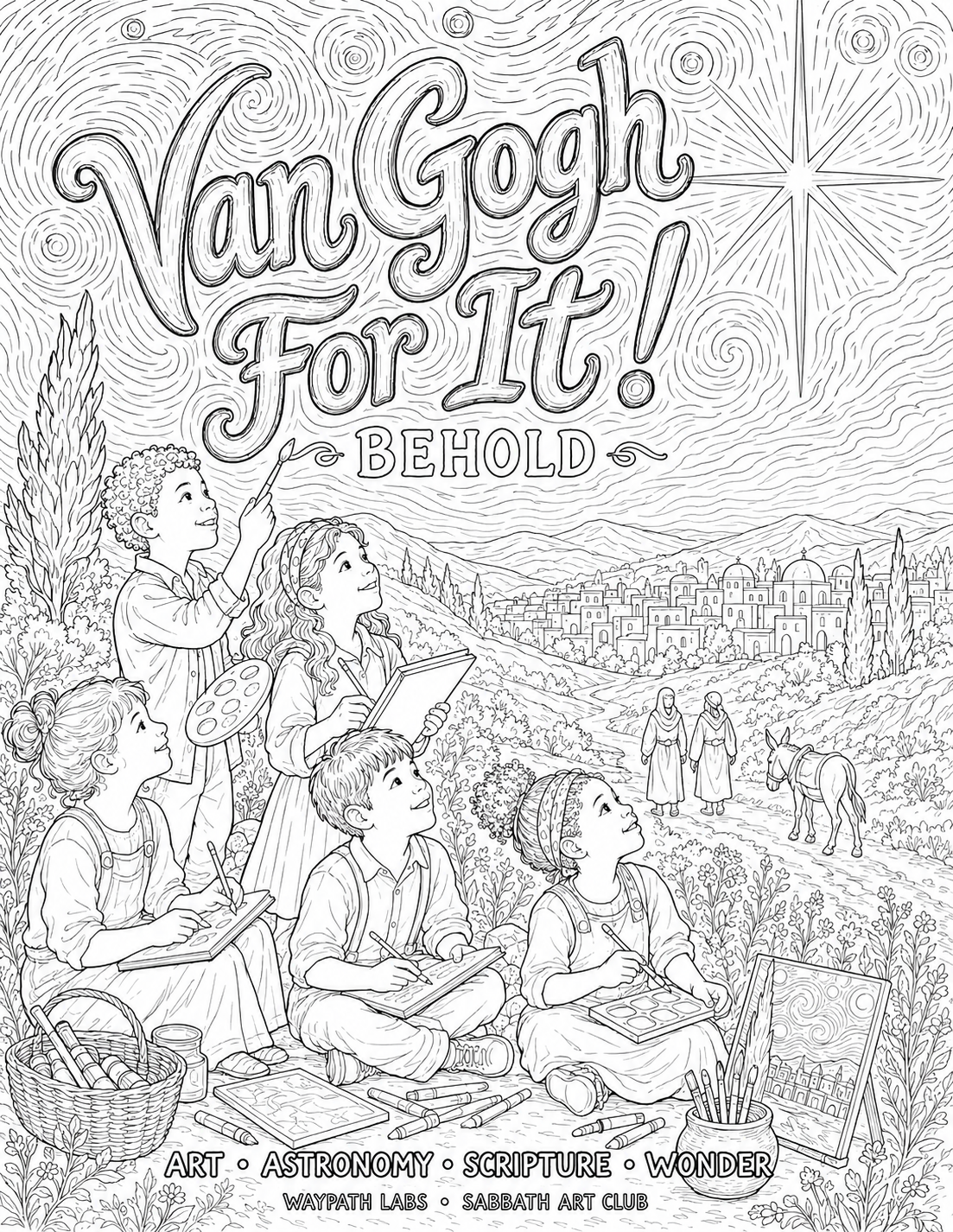
VAN GOGH FOR IT! · BEHOLD
Open the 11-page printable study →Look up. Pay attention. Create together.
The same painterly, consumable study online and in print: art history, Scripture, astronomy, Shaun's research lens, and an original Starry Night-inspired project.
PRINT · COLOR · CREATE
The coloring cover and illustrated lesson pages
Children can color the cover, follow the hand-drawn lessons, write directly on the pages, and create their own moving night sky.
VAN GOGH FOR IT! · STARRY NIGHT1
MEET THE ARTIST
Who was Vincent van Gogh?
1853–1890VINCENT
A painter who made color speak
Vincent van Gogh was a Dutch artist who used strong color and visible brushstrokes to show more than what a place looked like. He wanted a painting to carry feeling.
In 1889, while living in Saint-Rémy, France, he painted The Starry Night. The countryside was inspired by a real view, but Vincent rearranged and imagined parts of it.
Look. Circle. Wonder.
quietmovingbrightstormyhopefuldreamlike
SKETCH A QUICK IDEA
LOOK CLOSER · FOLLOW THE CLUES2
OBSERVATION + IMAGINATION
What did Vincent see—and what did he change?
REAL VIEWHills and countryside
+MEMORYA village and familiar shapes
+IMAGINATIONGlowing stars and a moving sky
=ARTA new way of seeing
Where does your eye go first?
Why might the sky feel so active?
What place would you paint from memory?
DRAW A REAL PLACE—THEN ADD ONE IMPOSSIBLE OR IMAGINED DETAIL
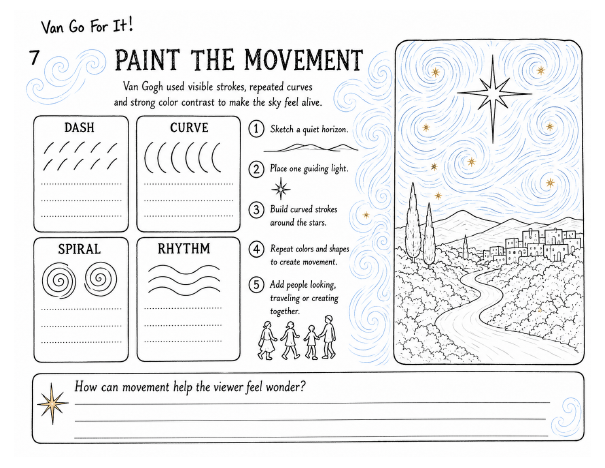
PAINT THE MOVEMENT · TECHNIQUE LAB3
TRY THE ARTIST’S TOOLS
Four marks can wake up a whole sky.
Practice each mark in the boxes. Change the size, direction, spacing, and pressure. Put a star beside the mark that feels most like you.
Use wide spacing and gentle curves.
Use tight spacing, bold spirals, and quick dashes.
CREATE YOUR STARRY NIGHT4
BORROW THE IDEA · MAKE IT YOURS
Your sky does not have to look like anyone else’s.
- Sketch a low horizon.Add hills, rooftops, trees, water, or your own neighborhood.
- Place one guiding light.Choose the first place you want the viewer to look.
- Build the movement.Use curves, dashes, spirals, and rhythm around the lights.
- Repeat your colors.Try two cool colors, one warm color, and one light accent.
- Add your story.Include a person, animal, path, or meaningful place.
CREATE YOUR MASTERPIECE HERE—or use a separate sheet for more room.
REMEMBER · SHARE · CELEBRATE5
THE ARTIST’S TABLE
Talk about choices—not who made the “best” picture.
FINISHING TOUCH
Name your artwork:
Display it on the refrigerator, frame it, or share it at your family’s artist table.
BEHOLD · RESEARCH LENS6
ASK · OBSERVE · TEST · RETURN TO THE TEXT
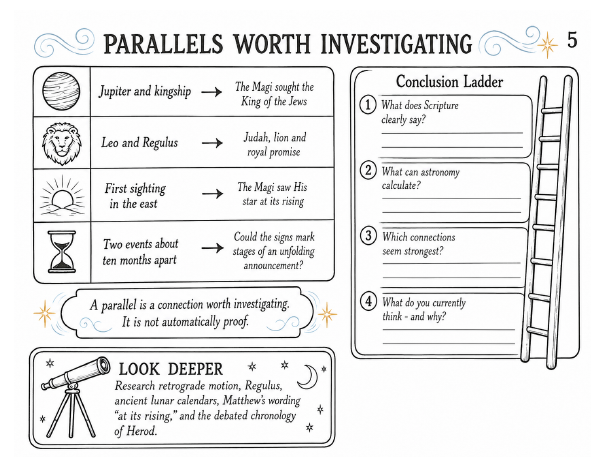
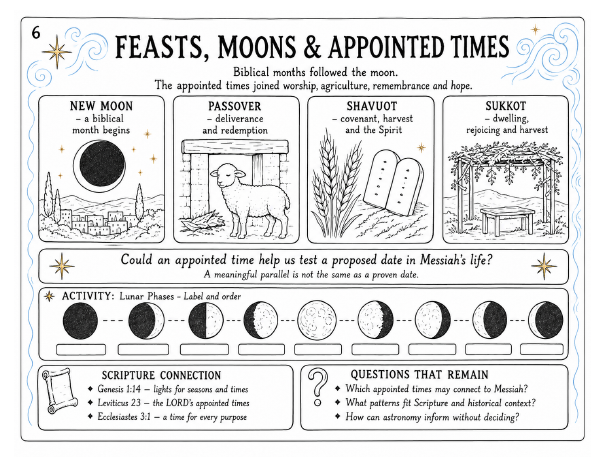
Can the night sky help us understand the historical setting?
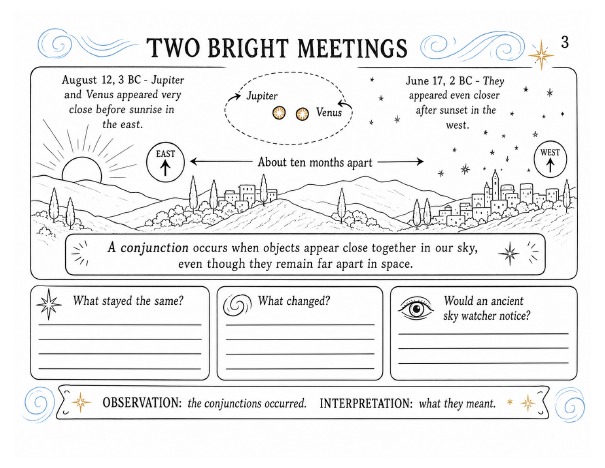
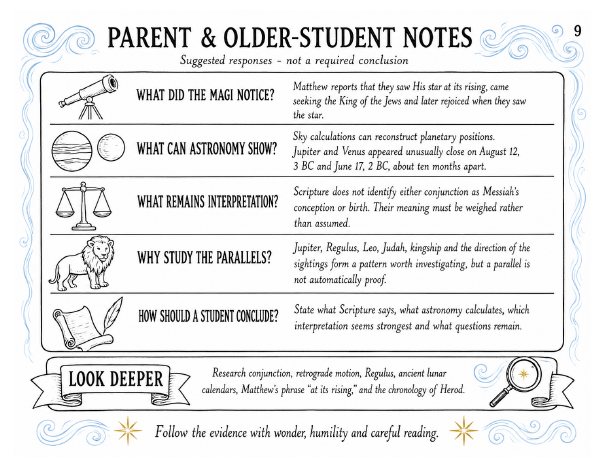
Shaun’s research begins with a real question: could unusual planetary meetings have helped ancient sky-watchers recognize an important season? This page preserves the research trail without calling one theory automatic proof.
Candidate sky events
- Jupiter–Saturn triple conjunction: 7 BCE
- Jupiter–Venus close meetings: 3–2 BCE
- Ancient observers tracked planets as “wandering” lights.
Dates depend on calendar system, location, and time of observation. Confirm them with reliable astronomy software before drawing a conclusion.
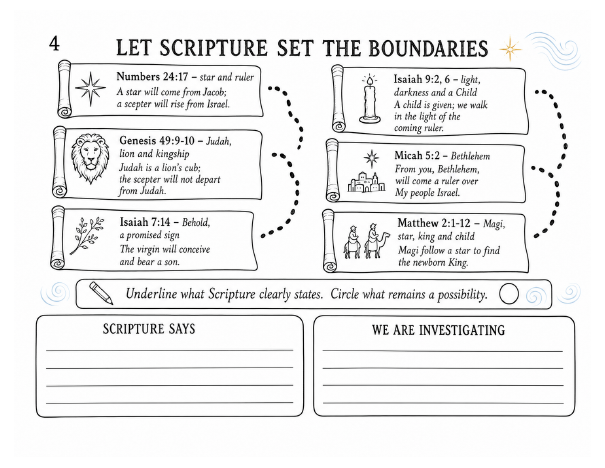
Read before interpreting
- Numbers 24:17 — a star and a scepter
- Isaiah 9:2, 6 — light and the promised child
- Micah 5:2 — Bethlehem
- Matthew 2:1–12 — the Magi observe and respond
Scripture tells us what the sign meant in the story; astronomy helps us investigate what may have been visible.
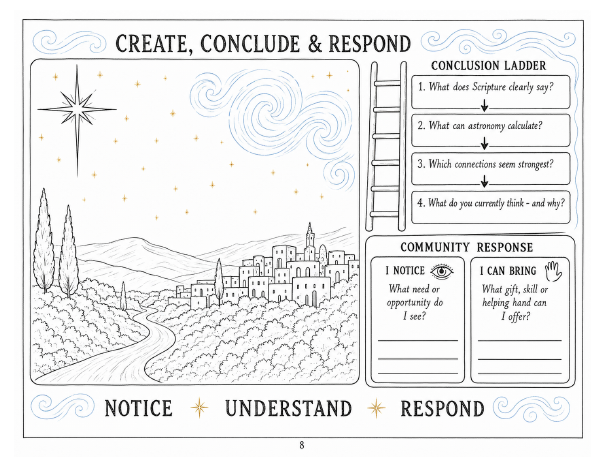
CONCLUSION LADDER1. What does the text actually say?2. What can astronomy calculate?3. What is a reasonable interpretation?4. What remains uncertain?
Which details appear in both the sky data and Matthew’s account?
What evidence would strengthen—or weaken—the proposed connection?
BEHOLD · PAY ATTENTION · RESPOND7
A WORD THAT INVITES US TO LOOK
“Behold” is more than seeing. It is a call to notice.
What do you observe in the passage or in creation?
What pattern, promise, or detail might be important?
What faithful action could follow what you learned?
CREATE A NIGHT SKY THAT GUIDES THE VIEWER TOWARD ONE IMPORTANT LIGHT. ADD A PATH OR FIGURE TO SHOW A RESPONSE.
PARENT + OLDER STUDENT NOTES8
GO DEEPER WITHOUT LOSING THE JOY
One lesson. Several ages. Plenty to explore.
Focus on finding shapes, naming colors, practicing one mark, and telling a story about the finished picture.
Compare observation and imagination. Explain how repeated marks create rhythm and guide the eye.
Research Post-Impressionism, analyze color contrast, and support an interpretation with evidence from the painting.